Going Back To The First Principles Thinking, Nature/Bio 2026 Revolution
Synopsis #
When Alan Turing and Jon von Neumann were thinking about computation, they kept coming back to biology. Turing spent his last years obsessed with how a single fertilized egg produces a leopard's spots, pattern formation from chemical gradients, order from noise. Von Neumann was building self-replicating automata, directly inspired by how cells copy themselves. The most foundational thinkers in computing were essentially asking: what if nature already solved this?
We forgot to keep asking that question.
I created a community of people who want to pick it back up, curated researchers, hackers, scientists, engineers, all obsessed with everything "bio". Biotech to biohacking, bio-resilience, longevity or organoid/synthetic intelligence to biosecurity, wetware to wetlab. Bring your papers, half-baked experiments, ideas, projects, and questions you're afraid to ask in a seminar room.
Motivation for this community #
Biology is having its homebrew moment. The parallel isn't just cute, it's the actual lineage. Every hacker movement starts the same way: someone decides the tools shouldn't be locked behind an institution. The Whole Earth Catalog ran on a two-word creed, "access to tools," the belief that if you put real equipment and real knowledge in ordinary people's hands, they'll build things the gatekeepers never imagined. The Homebrew Computer Club was that idea in a room, a bunch of hobbyists trading parts and schematics in a garage, and the personal computer fell out of it. Nobody there had permission. They just started.
Biopunk is that same energy pointed at cells instead of circuits. Garage biology, community wet labs, cheap experiments run by people who taught themselves, projects shared openly so the next person can fork the protocol instead of rediscovering the dead end. The bet is that biology in the 2020s looks like computing in the 1970s: expensive, mysterious, and quietly about to be handed to anyone curious enough to pick up the tools.
Decentralized science and open communities/labs matter because they attack biotech's real bottleneck, which isn't talent or ideas but access. For most of the last century, doing biology meant belonging to an institution: a university group, a pharma lab, a funded PI with a six-figure floor before you could run a single experiment. That gate quietly decided whose ideas got tested and whose died unexamined. Open community labs break it. They work a bit like a WeWork for wet lab space, pooling reagents, equipment, and expertise so a curious person can run a real experiment for a few thousand dollars instead of a few hundred thousand, alongside people who actually want to help.
The deeper point is the mindset. Science should be less gated. It shouldn't be locked inside academic groups you can only enter with the right credentials and the right supervisor. It should be open to anyone curious enough to actually try. What decentralized science borrows from tech is the hacker attitude: self-teach, experiment, break things, and do it yourself instead of waiting years for a PhD, a mentor, a PI, or a big lab to grant you permission. You don't need any of that to begin. You can just start, on your own, right now, with a cheap experiment and a community lab down the road. And this is exactly where the acceleration comes from. When you remove the gate, you widen the funnel. Thousands more people get to test ideas, and they get to test them in months instead of after a decade of climbing an academic ladder. A capable person in Kenya or India gets the same shot as someone at Stanford or MIT, which means the pool of experiments stops being filtered by geography and prestige and starts being filtered by curiosity. More shots on goal, run in parallel, shared openly so nobody repeats the same dead end, compounds fast. Most will fail, and that's fine, because the whole system is built for cheap failure and public learning. The long-term vision is a world where biology is something you can just do, where community science is visible and normal enough that people stop assuming it only happens inside big institutions, and where the sheer number of independent, curious people running small experiments becomes the thing that moves science forward faster than any single gated lab ever could.
Historical and present initiatives #
Genspace opened in Brooklyn in 2009 as the world's first community biology lab, and it's still running, with BSL-1 lab space anyone can use for their own project and a stated belief that science is for everyone, not a chosen few. BioCurious, in Silicon Valley, calls itself the largest community lab space for biology and is entirely volunteer-run. Counter Culture Labs in Oakland bills itself as a "community supported microbiology maker space" and shares a warehouse with a hackerspace, which tells you exactly what kind of energy it runs on.
And the projects coming out of these places aren't toys. Counter Culture Labs runs Open Insulin, an effort to develop an open-source protocol and microbial strains to produce insulin cheaply, so the recipe for a life-saving drug isn't locked behind a handful of manufacturers. BioCurious and CCL together produced Real Vegan Cheese, engineering yeast to make actual milk proteins with no cow involved. Membership at these labs runs something like $80–100 a month. That's the price of access to real molecular biology, and people are using it to take on problems that big institutions have left alone. Cheap access plus a community plus an open, sharing mindset, and suddenly a type-1 diabetic in a garage lab is reverse-engineering insulin. Primordia and Biopunk are extending a lineage that's already proven it can produce this stuff.
The thing that made tech's hacker culture explode wasn't just cheap computers. It was that nobody had to build from zero. You cloned a repo, tweaked it, and shipped. Biology is getting its version of that, and it's the piece that makes the whole "just start" argument realistic. Take lab robots. A traditional liquid-handling robot, the machine that does the mind-numbing pipetting for you, runs well into six figures from the big instrument vendors. Opentrons builds an open-source one, the OT-2, that starts around $10,000, and it's a genuinely open-source liquid handler designed for scientists to use and adapt. The software is open-source too, so users can modify it to interface with other equipment, and protocols are written in a Python API that anyone with basic coding and wet-lab skills can use. A shared protocol library, code you can download and edit, hardware other people have already figured out how to hack.
The same pattern shows up everywhere in this world. Need a plasmid? There's a nonprofit repository where labs deposit and share them, so you request someone's construct instead of building it yourself. Protocols get published openly. DIY hardware plans circulate. The point isn't that any one tool is free. It's that the whole ecosystem is built around not reinventing the wheel. Fork the protocol. Tweak it. Run it in a community lab. Share what you learn so the next person forks yours. That loop is the entire reason biology can now move at hacker speed.
What this community is for #
It's for people who think everything is connected and can't stop noticing the connections. Who feel mildly crazy in most professional spaces because "that's not your field." Who read a paper on slime mold navigation and immediately think about distributed computing, and then think about collective intelligence, and then think about how markets work, and then realize it's 3am.
No borders or visa restrictions, no gatekeeping by institution or credential. We all have times where we get rejected and dismissed by exisiting institutions/systems that's where we realize the game is far bigger than us but we have to eventually start somewhere. We don't need to be in San Francisco to start it, we can start small on discord on my Acer Nitro laptop in India.
The conversations span drug discovery, wetlab automation, biological neural networks, what "intelligence" even means below the level of the brain, how you'd actually integrate wetware with silicon substrates today, and the philosophy underneath all of it. Ask fundamental questions, drop a 1970s or 2019 paper that's underrated, run an experiment and share your findings.
Who am I #
Someone with a computer science and hardware/architecture background who ended up deep in neuromorphic computing research and couldn't stop asking biological version of it. Inspired by this book, we need to change the way we approach problems in biology and I decided to build autonomous labs full-time.
Come in #
DM me for an invite if you're exploring biotech, biocomputing, biohacking, biosecurity, or anything adjacent. If people call you delusional and you have interdisciplinary interests across psychology, philosophy, sciences, tech and sci-fi, that's exactly the filter. Let's think in systems together and discuss moonshot ideas that probably sound insane until they don't. Also, I would love to support and collaborate with such existing initiatives in deep-tech/research. Let's discuss.
Find me on Twitter, LinkedIn, or email.
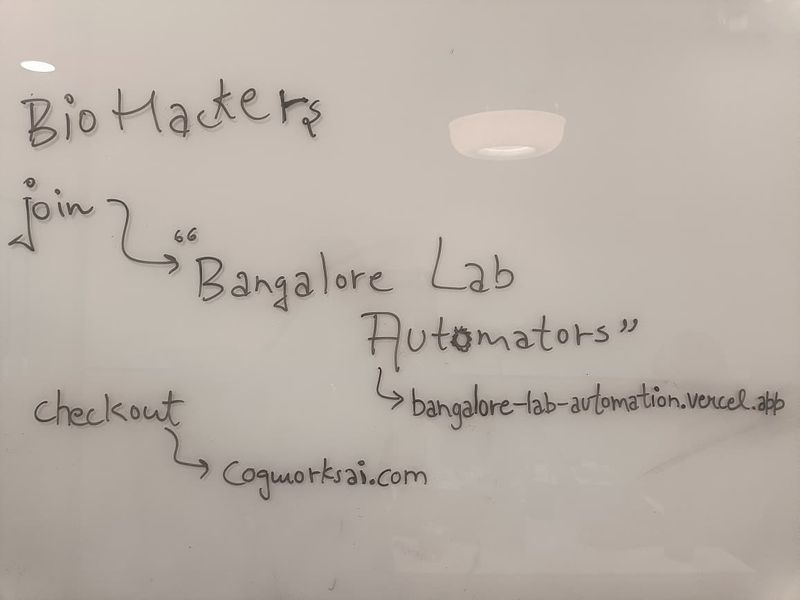
Right now we're remote on Discord and WhatsApp. More to come -> Bangalore Lab Automators (Inspired by Bay Area Lab Automators community). stay tuned :)